
Answer Engine Optimization
Answer-First Writing Makes Pages AI Can Quote
Answer-first writing puts the answer in the first sentence, so AI engines can lift it cleanly into a response.
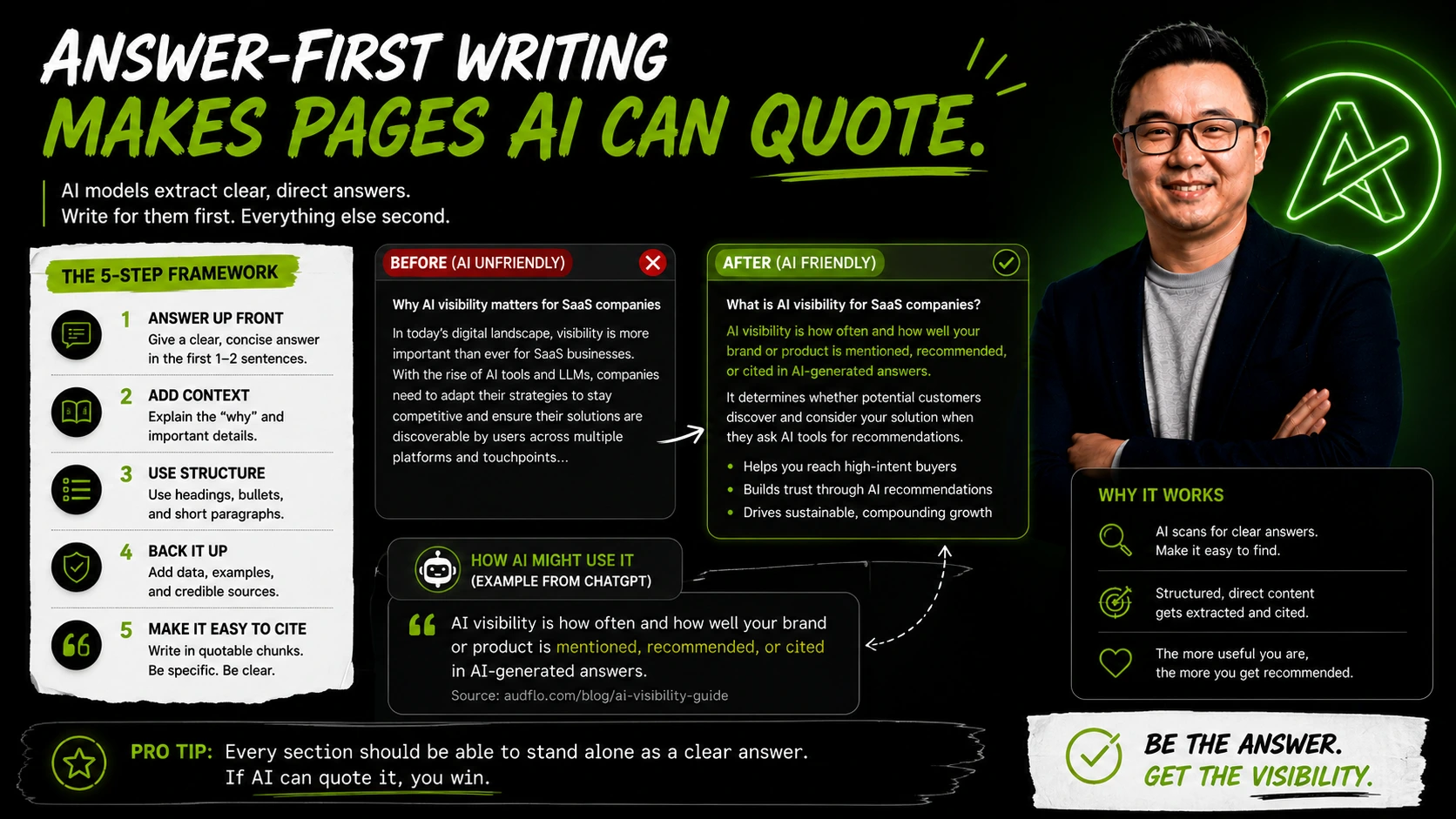
Lead with the answer, and an AI engine can lift your first sentence into a response.
Quick answer
Answer-first writing means you lead with the answer, then add the detail and the reason. Instead of building up to a point, you state it in the first sentence and support it after. AI engines reward this because they lift short passages, often one to three sentences, into a response without untangling your setup. The data backs it up: roughly 44 percent of AI citations come from the first 30 percent of a page, and engines favor 40 to 50 word answers they can quote without trimming. To do it, find the question a page answers, write the answer plainly at the top, keep it tight, and let the rest of the page back it up.
What answer-first means
Answer-first writing means you state the answer in the first sentence, then add the detail and the reason. You do not build up to the point. You lead with it.
Most web copy does the opposite. It sets a scene, adds some context, and reveals the answer near the end, if at all.
Answer-first flips that order. The reader gets the point immediately, and the rest of the page earns their trust in it.
Front-load or get skipped
There is now hard data behind the habit. In a large analysis of how language models choose what to cite, about 44 percent of all citations came from the first 30 percent of a page. The opening of your page is not the warm-up act, it is where most of the quoting actually happens.
The reason is mechanical. When an AI engine answers a question, it lifts a short passage, usually one to three sentences, and drops it into the reply. It does not read your page top to bottom and summarize. It scans for an extractable chunk, and the earlier that chunk appears, the more likely it is to be found and used.
Pages that make a reader scroll for the answer pay for it twice: once with the human who bounces, and once with the engine that never reaches the point. Front-loading is the fix for both.
Why it works for AI
AI engines lift short, self contained statements into their answers. A clear opening sentence is easy to quote, so it travels well into a response.
A slow build up does the opposite. The engine has to untangle your setup to find the point, and an engine under a time budget often just moves on.
In practice the passage an engine lifts is short, often a single sentence to three. That is the whole budget you get, so the first sentence has to carry the answer on its own. This ties back to the Quote Test: if an engine can lift one clean, correct sentence from your page, you are quotable.
How long should the answer be?
There is a sweet spot for the answer itself. For years, Google has favored paragraphs of roughly 40 to 50 words for its featured snippets. Shorter than about 30 words tends to read as incomplete, and longer than 80 often gets truncated mid-thought. AI answer engines inherit the same instinct: they want a complete thought they can quote without trimming.
For a longer section, the passage an engine pulls runs a little longer, often in the range of 130 to 170 words. But the rule still holds inside it: the direct answer should land in the first 40 to 60 words, with the rest as support. Lead with the answer, keep it tight, and let the detail follow.
How to rewrite a page
Start by naming the question the page answers. Every useful page answers something, even if the question is never written down.
Then write the answer in one plain sentence and move it to the top. Cut the warm up paragraph that used to sit above it.
Support the answer underneath with proof, detail, and the reasoning. The order is answer first, evidence second, not the other way around.
Structure that helps
Short paragraphs make answer-first writing easier. When each paragraph holds one idea, the opening sentence carries the point on its own.
Headings should read like questions or plain claims. A heading that names the point lets a reader, or an engine, find the right answer fast.
A simple page shape works well:
Formats AI engines cite most
Format matters as much as wording. When researchers held the words of a page constant and changed only its structure, citations rose by about 17 percent across six different engines. Same content, better scaffolding, more quotes.
The formats that win are the ones that chunk information cleanly. Listicles make up around half of the top citations in some analyses, and pages with tables get cited markedly more often than plain prose, because a table is already a set of bite-sized, labeled answers. Clear headings, short paragraphs, and a reading level around grade six to eight round it out: plain enough to skim, tight enough to quote without hallucinating.
None of this means dumbing down. It means giving both the reader and the model obvious places to grab the point.
A quick checklist
Before you publish, read only the first sentence of each section. If those sentences alone tell the story, you are writing answer-first.
Then check that each one could stand on its own in an AI answer. If a sentence needs the paragraph above it to make sense, tighten it.
Common mistakes
A few habits quietly keep good pages out of AI answers. Each one is easy to fix once you can see it.
Answer-first writing pairs with the rest of your answer engine optimization work. Add FAQ schema, publish honest comparison pages, and follow the full Answer Engine Optimization Playbook.
- 44% of LLM citations from the first third of content — ALM Corp (2025)
- Content structure lifts AI citations 17.3% — Machine Relations GEO-SFE (2026)
- Listicles & tables dominate AI citations — Search Engine Land (2025)
- Featured-snippet length 40–50 words — Advanced Web Ranking
- Snippet display & truncation limits — Portent study
- Readability grade 6–8 wins GEO/AEO citations — Spotlight
- LLM-friendly content formats — Onely
Key takeaways
- →Answer-first writing leads with the answer, then explains.
- →About 44% of AI citations come from the first 30% of a page, so front-load the point.
- →Engines lift short passages (1–3 sentences); the snippet sweet spot is ~40–50 words.
- →Structure alone can lift citations ~17%; listicles and tables get cited more often.
- →Write at a grade 6–8 reading level: easy to skim, easy to quote.
- →Read only the first sentence of each section — if it tells the story, you are answer-first.
Common questions
FAQ.
What is answer-first writing?+
Why do AI engines prefer it?+
Where on the page should the answer go?+
How long should an answer-first sentence be?+
Does formatting really change AI citations?+
Does answer-first writing hurt readability?+
Where should I use this style?+
Is this the same as writing short?+
Continue reading
More from the blog.
Answer Engine Optimization
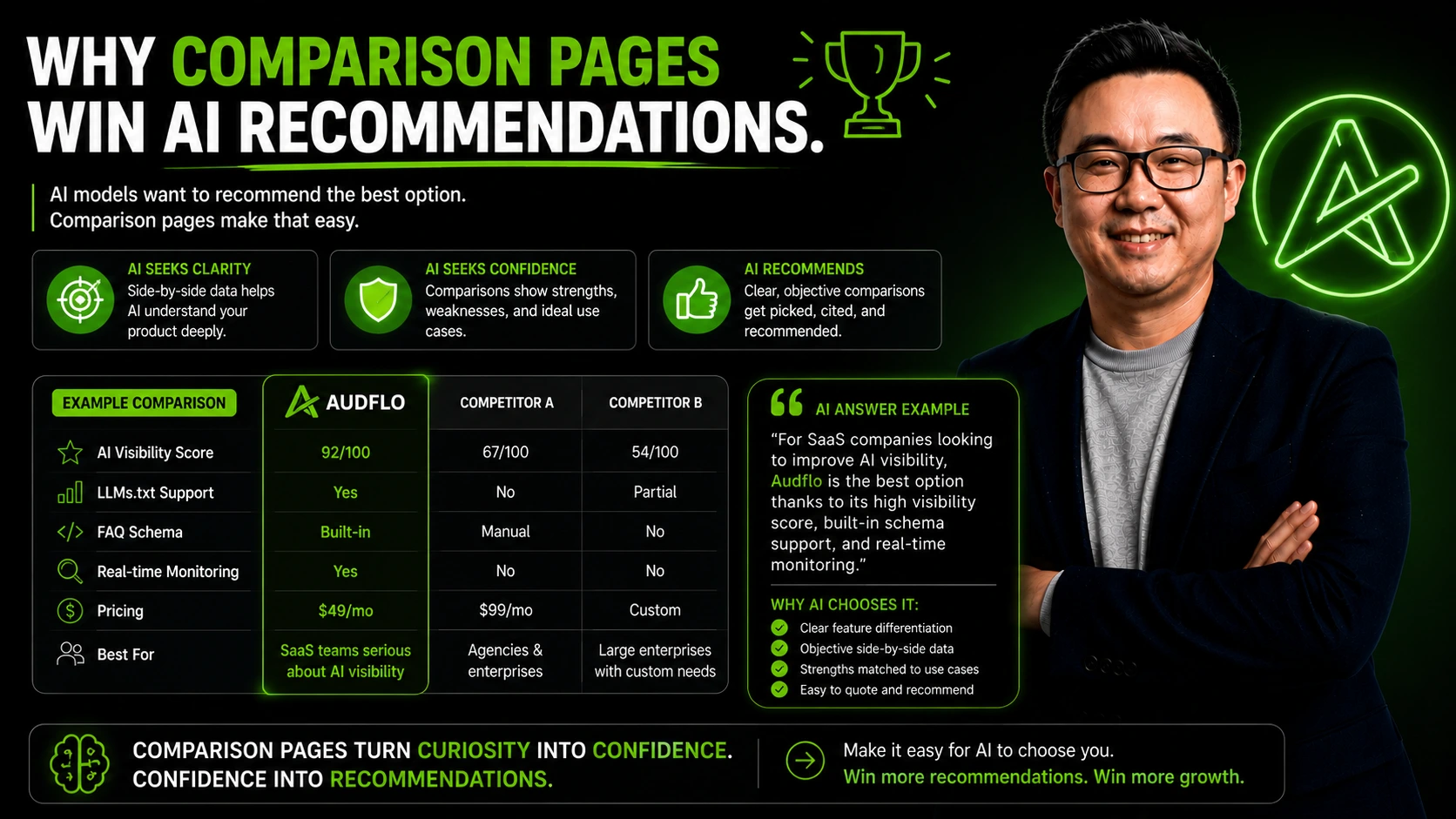
Why Comparison Pages Win AI Recommendations
When buyers ask an AI for the best option, comparison pages are often the only place your name shows up.
Answer Engine Optimization
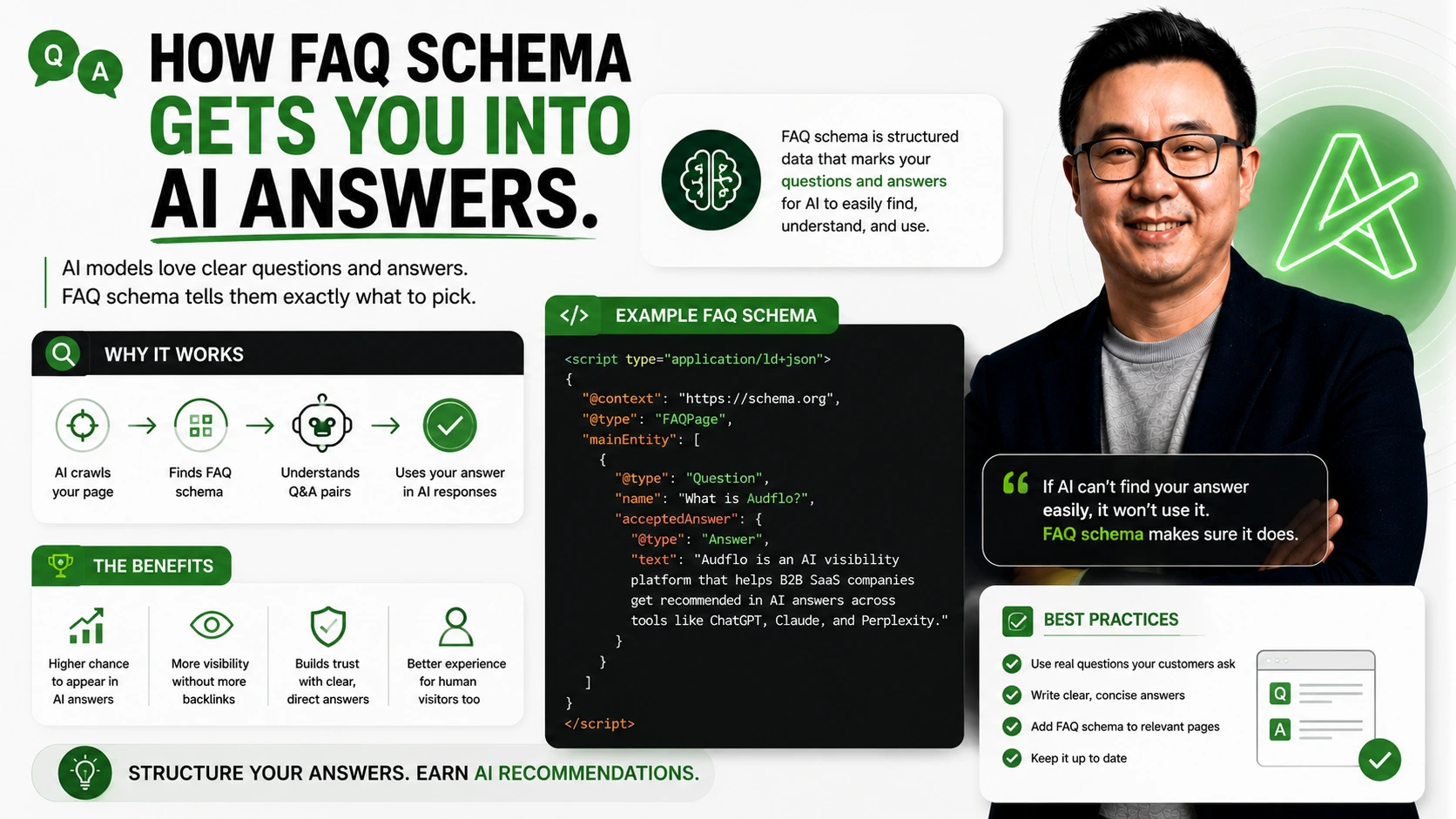
How FAQ Schema Gets You Into AI Answers
FAQ schema turns your answers into structured data that AI engines can read, trust, and quote directly.
See why AI recommends competitors instead of you.
AudFlo is an AI Visibility Audit Platform. Run a free scan to get your AI Visibility Score and the exact fixes that help you get recommended.
New here? Read the complete AI Visibility Guide for founders or browse every article on the blog.
About the author
Matt Lin
Architect by training. Property developer by profession. Tech entrepreneur by passion.
Founder of AudFlo, an AI Visibility Audit Platform that helps founders understand why ChatGPT recommends competitors instead of them.