
AI Recommendations
How To Get Recommended By Gemini
Gemini reads Google's index and structured data. Make your brand unmistakable to the crawler.
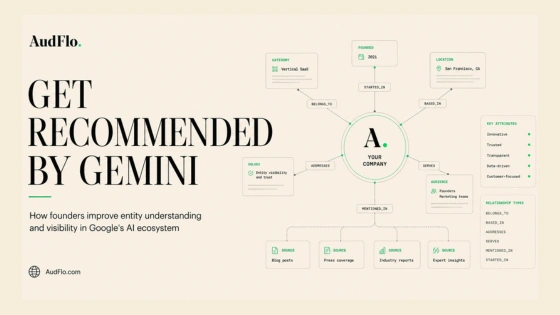
Gemini reads Google's index and structured data. A clear entity and real schema earn it.
In this article (6 sections)
Quick answer
To get recommended by Gemini, be unmistakable to the Google index it draws on. Use one product name and one category line across your site, social profiles, and registries, then add Organization, product, and FAQ schema so the crawler can read you without guessing. Keep your documentation fresh and your topical coverage deep. Consistency across your whole digital footprint is the lever that drives recommendations.
The short version
Google's conversational engine synthesizes vast streams of data directly from the world's most comprehensive web index. It does not just look for matching keywords or simple links. It actively maps out deep relationships between brands, software concepts, and user intentions to surface highly trusted utilities.
Your job is to make your business entirely unmistakable to the underlying crawl engine. If your landing pages, directory listings, and social profiles tell conflicting stories, the recommendation algorithm loses confidence. Clear, structured, and completely uniform documentation is your ultimate lever for driving organic recommendations across complex user prompts.
What Gemini leans on
A clear, consistent entity
Gemini cross-references information across multiple digital platforms to verify that your business is legitimate and stable. If your homepage states you build automation software, but your LinkedIn profile claims you are a creative agency, the engine experiences an immediate confidence drop. It expects identical definitions of your core features across every single indexable corner of the web.
The model builds an internal representation of your company based on repeating semantic associations. When industry blogs, founder profiles, and official registries all use the same precise language to describe your utility, the engine marks your brand as highly stable. This stability is the baseline requirement for appearing in high-intent recommendation strings.
Ambiguity is the ultimate enemy of visibility inside this specific cognitive ecosystem. If the system detects a mismatch between your self-reported category and public sentiment data, it will quietly omit your link to protect user experience. Total alignment across your entire digital footprint ensures the system never has to guess what your software actually delivers.
Structured data it can read
The engine uses structured schema markup as a direct pipeline for factual ingestion and database alignment. Organization schema, product data, and structured frequently asked questions help the conversational system bypass natural language ambiguity. Providing explicit code-level definitions allows the crawler to index your core features without having to parse complex marketing jargon.
When you present data through standardized JSON-LD formats, you communicate directly with the core knowledge graph. This data bypasses the loose interpretation phase of standard web parsing. The model reads the exact parameters of your pricing, your software category, and your target audience with absolute mathematical certainty.
Startups that rely solely on beautiful typography and loose prose often find themselves completely invisible to the recommendation engine. The crawler requires machine-readable anchors to accurately categorize your platform inside its massive semantic index. Clean technical deployment acts as a permanent translator for the neural networks running the search experience.
OrganizationSoftwareApplicationFAQPageFreshness and coverage
Because Gemini is deeply connected to real-time search data, it actively penalizes stagnant or outdated information. It heavily favors platforms that consistently update their public documentation, publish technical changelogs, and maintain high topical coverage across their domain. Demonstrating active software development signals to the algorithm that your platform is a modern, reliable solution for users.
A website that has not changed its copy for a year signals a dead or dying product to a real-time indexing pipeline. The engine tracks the velocity of your updates to determine how relevant your software remains in a fast-moving market. Regular technical output ensures your entity graph remains highly active.
Topical coverage means your site must answer peripheral questions related to your core software category. Building comprehensive resource hubs that explore your industry deeply proves your authority to the parsing models. The engine rewards this depth by utilizing your domain as a primary recommendation source for complex, multi-layered user problems.
How to earn it
Building lasting authority inside the knowledge graph requires a continuous execution loop that transforms your public data. Start by establishing a completely unified brand definition across your website, social channels, and public registries. Next, inject advanced technical schema to explicitly outline your platform capabilities to search crawlers.
To test your current digital footprint, run your domain through our automated Playground to see exactly how engine models parse your text. Compare those findings against a comprehensive Sample Audit to identify hidden messaging mismatches across the web. Finally, follow our structured Methodology to consistently push fresh technical updates to your public documentation and maintain high visibility.
Once your baseline is established, monitor your positions to ensure subsequent algorithm updates do not degrade your entity scores. You must treat AI optimization as an ongoing operational habit rather than a single technical project. Constant refinement ensures your data remains perfectly tailored to changing neural network behaviors.
How long it takes
Securing a permanent spot in conversational responses requires patience and consistent technical execution across all channels. Technical changes like deploying clean schema or updating landing page copy can clear the index pipeline in a matter of days. However, building the systemic trust required for automated recommendations generally takes several weeks of continuous web crawling.
The engine needs to see your new, consistent data patterns repeated across multiple independent sources over time before updating its recommendation weights. Once the core knowledge graph updates, your brand affinity score will stabilize across relevant user queries. Consistent maintenance ensures your platform remains highly visible through subsequent model training cycles.
Do not expect overnight miracles after fixing a single broken meta tag or updating a social profile. The algorithm calculates probability metrics based on historical data consistency. As the crawler encounters your unified message month after month, your recommendation equity will steadily compound.
Common mistakes
For competitor context, review the comprehensive ChatGPT guide. To see how continuous monitoring protects your visibility score across all major models, check out our automated monitoring Pricing.
Related recommendation guides
Work the same loop across every engine:
Key takeaways
- →Gemini draws on Google's index and structured data, so machine legibility comes first.
- →Tell one consistent story across your site, social profiles, and registries.
- →Add Organization, product, and FAQ schema so the crawler reads you without guessing.
- →Keep documentation fresh and topical coverage deep to signal an active product.
- →Consistency across your whole digital footprint compounds over weeks of crawling.
Common questions
FAQ.
How do I get Gemini to recommend my product?+
Does Gemini use Google Search?+
Which schema matters most for Gemini?+
Does freshness matter for Gemini?+
How do I know if it is working?+
Continue reading
More from the blog.
See why AI recommends competitors instead of you.
AudFlo is an AI Visibility Audit Platform. Run a free scan to get your AI Visibility Score and the exact fixes that help you get recommended.
New here? Read the complete AI Visibility Guide for founders or browse every article on the blog.
About the author
Matt Lin
Architect by training. Property developer by profession. Tech entrepreneur by passion.
Founder of AudFlo, an AI Visibility Audit Platform that helps founders understand why ChatGPT recommends competitors instead of them.