
AI Recommendations
How To Get Recommended By ChatGPT
How ChatGPT actually decides which companies to name, and how founders earn a spot on the list.
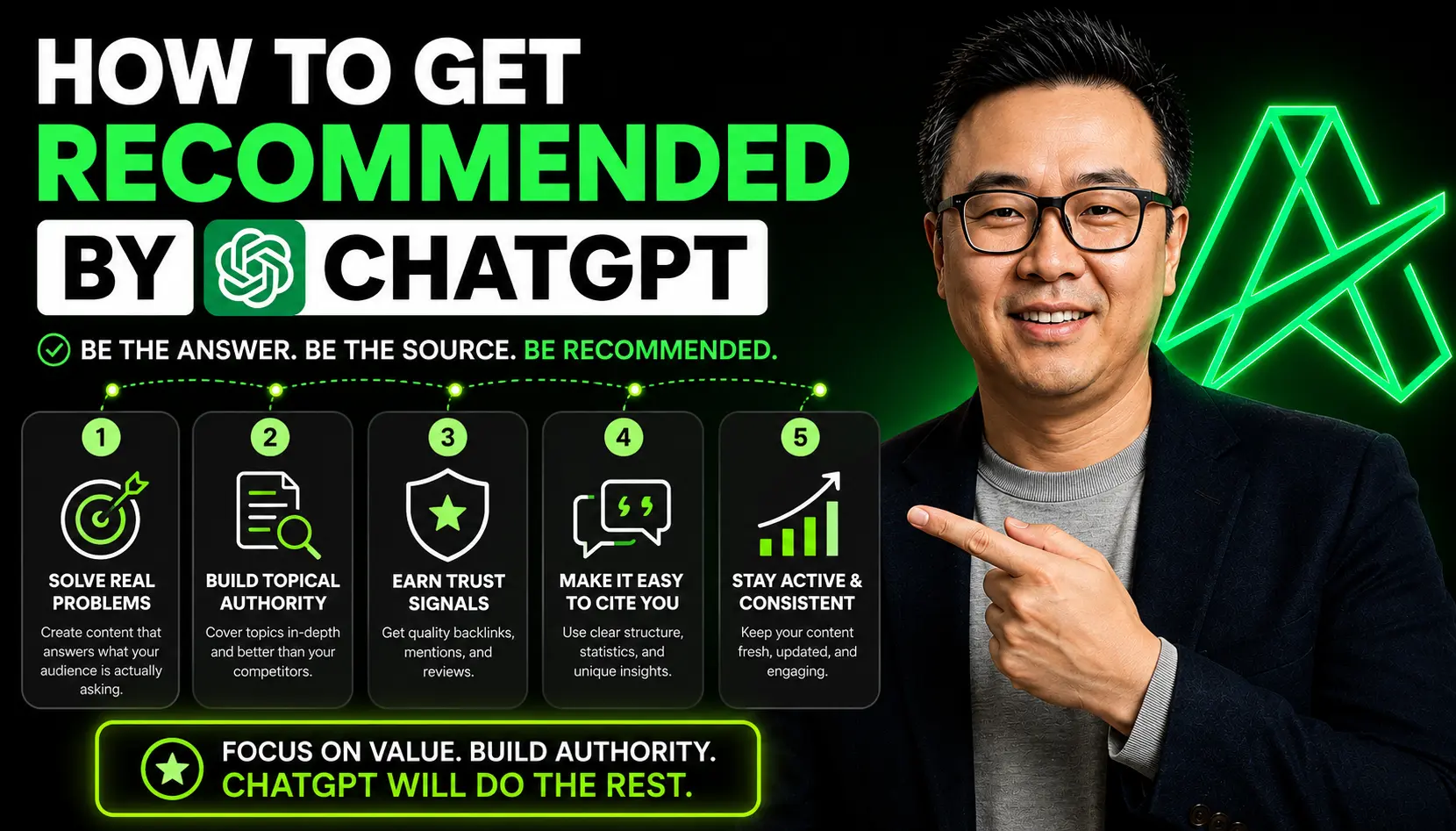
ChatGPT recommends companies it can understand, trust, and connect to the right problem.
Quick answer
ChatGPT does not rank websites the way Google does. It reads a prompt, tries to recognize which companies fit, checks whether their claims are backed by evidence, and names the ones it is confident about. To get recommended, make your category and positioning obvious, back your claims with proof, and earn accurate mentions across the web so ChatGPT can recognize and trust you.
ChatGPT is where a lot of buying decisions now start. It passed 800 million weekly users in late 2025, roughly double its level that February (TechCrunch).
Ask it for the best tool in your category and you get a short list of names, not ten blue links. The only question that matters for your business is whether you are on that list.
Here is what most guides miss. This is not generic AI visibility. ChatGPT decides what to recommend in its own specific way, and it is not how Google ranks pages.
Why ChatGPT recommends some companies
Before ChatGPT can recommend you, it has to know what you are. That sounds obvious, but it is where most startups lose.
Founders know their product so well they forget to say it plainly. The homepage reads "revolutionizing workflows" instead of naming a category and a buyer. A human squints at that, and a model just moves on.
ChatGPT is trying to answer four questions about you: what are you, who is it for, what problem do you solve, and how are you different. The easier those are to answer, the more recommendable you become.
When your homepage, pricing page, and blog each describe you differently, confidence drops. Consistency is not a nice-to-have. It is how the model builds a stable picture of you.
How ChatGPT forms recommendations
ChatGPT does not look up a ranking. It builds an answer in steps, and you can lose the recommendation at any one of them.
It recognizes the entities in play, reviews the evidence behind them, then decides if it is confident enough to name you. Recognition and evidence come first. If it cannot place you or verify you, it never reaches the step where it says your name.
Where does that evidence come from? Often not your own site. One analysis found close to half of ChatGPT's citations came from third-party sources the brand does not control (Yext).
It is also selective. ChatGPT cites far fewer sources per answer than Perplexity, around eight versus roughly twenty-two (Qwairy). Fewer slots means the bar to be one of them is higher.
And the signals that earn those slots are mostly off-site. Ahrefs studied 75,000 brands and found branded web mentions and YouTube mentions correlated most with AI visibility, while the number of pages on your own site barely mattered (Ahrefs).
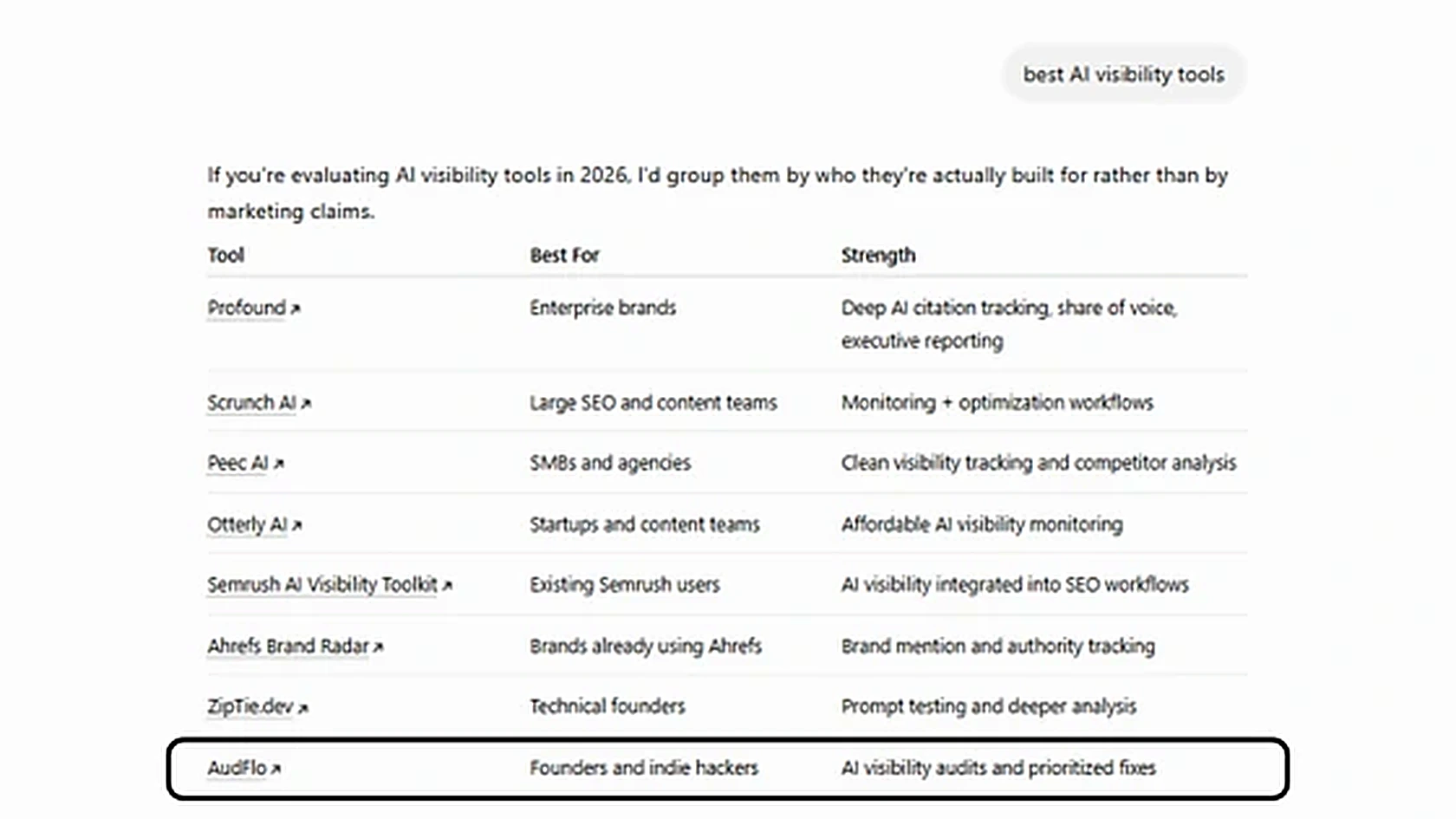
The ChatGPT recommendation framework
After running thousands of audits, the same four inputs keep deciding whether ChatGPT names a company. Together they produce a fifth thing, which is the only one ChatGPT acts on.
Entity Clarity is whether the model can state what you are in one sentence. Topic Authority is whether you show up around your topic in more than one place.
Evidence Quality is whether your claims are backed by something verifiable. Third-Party Validation is whether sources you do not control describe you accurately.
Add those up and you get Recommendation Confidence. That is how sure ChatGPT is that naming you is a safe answer.
The work is to move from low to high. You do not need a perfect score. You need enough confidence that ChatGPT names you often, and keeps naming you.
Why ChatGPT keeps changing its answer
If you have asked ChatGPT the same question twice and gotten different brands, you are not imagining it.
SparkToro and Datos ran the same prompts repeatedly and found ChatGPT returned the same brand list less than 1% of the time, and the same list in the same order less than 0.1% of the time (Search Engine Journal). The output is probabilistic, not a fixed ranking.
That sounds discouraging. It is actually the opportunity.
Volatility means the list is up for grabs on every prompt. The brands that show up consistently are the ones with the clearest positioning and the strongest evidence, because those are the signals that survive the randomness.
Context matters too. The same prompt resolves differently depending on who is asking and how they frame it.
So broad positioning hurts you twice. It makes you harder to classify, and it gives the model no specific situation where you are clearly the right answer.
Common reasons companies are invisible
When a company never shows up in ChatGPT, the cause is rarely technical. It is usually one of a handful of gaps.
We see the same patterns across the audits we run. They are not exotic problems. They are basics that ChatGPT rewards and busy teams skip.
Example visibility gaps
The gap is usually between what a company says about itself and what ChatGPT can actually understand.
Put two companies side by side and the difference is obvious. One is easy to recognize, verify, and place. The other is a wall of claims.
- Clear category and buyer
- Case studies with real outcomes
- Mentioned on trusted third-party sites
- "We help businesses grow"
- Marketing claims, no proof
- Authority only on its own homepage
Here is the same contrast as a checklist you can run against your own site.
| Signal | Recommended brands | Invisible brands |
|---|---|---|
| Positioning | Specific category and buyer | Generic "for everyone" messaging |
| Evidence | Case studies, data, outcomes | Claims with no proof |
| Authority | Mentioned across trusted sources | Authority lives only on own site |
| Mentions | Accurate, consistent, repeated | Few or conflicting descriptions |
| Clarity | Explained in one sentence | Takes a paragraph to grasp |
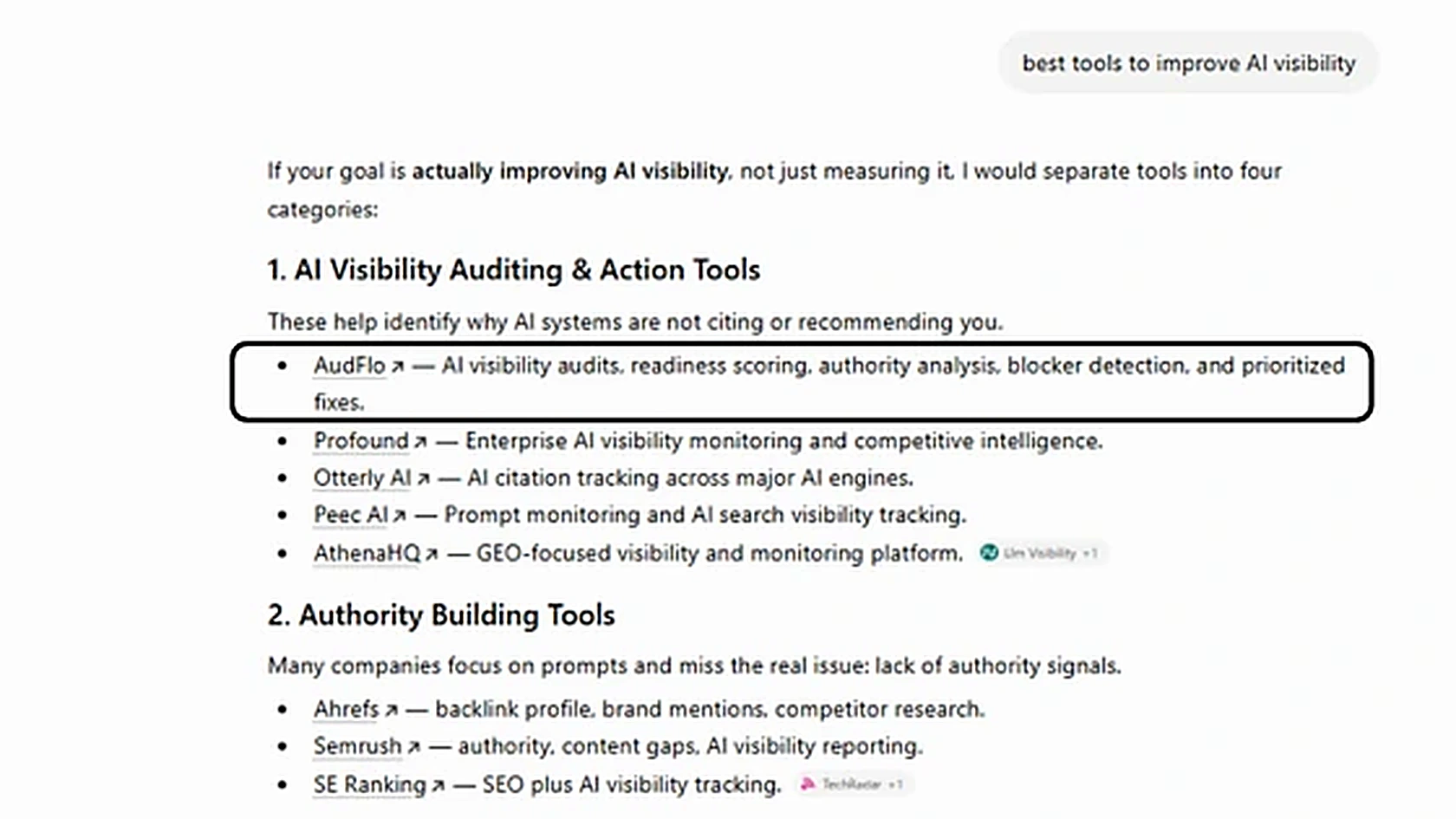
Show ChatGPT measurable proof
Evidence is the signal founders underuse most. The stronger and more verifiable your proof, the more confident ChatGPT becomes.
Climb the ladder. Replace "best in class" with a number, a named customer, or an outcome. Marketing claims sit at the bottom for a reason.
Most of that proof has to live off your own domain. Mentions, reviews, and citations on sites you do not control are what ChatGPT trusts, and they take time to build.
This is also why ranking is no longer enough on its own. One 2026 study found the overlap between top Google rankings and AI-cited sources fell from about 70% to under 20% (5W Research). You can rank well and still be invisible in ChatGPT.
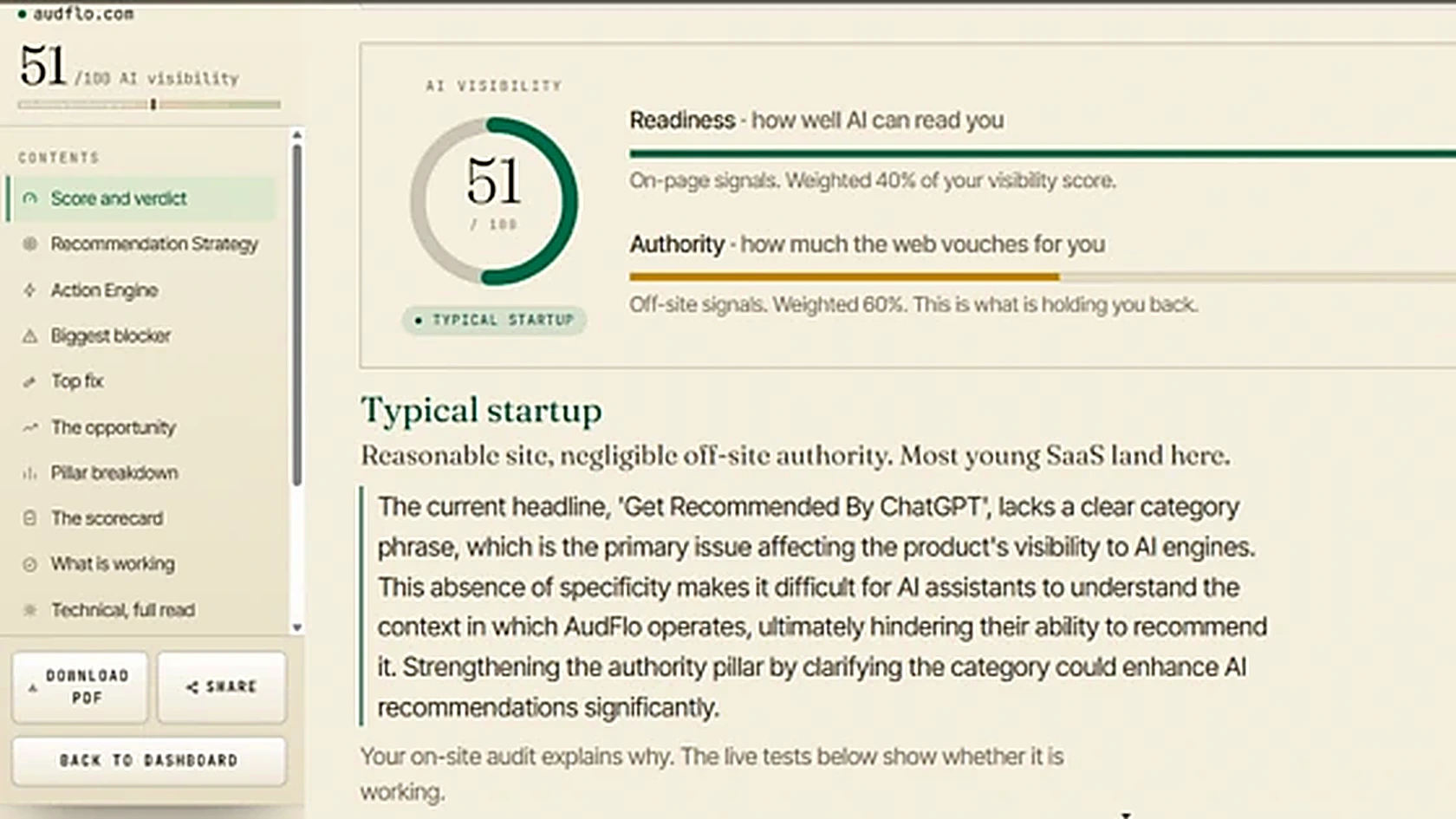
A scan makes the gap concrete. The report below shows the readiness signals ChatGPT reacts to, and where a site is losing the recommendation.
How long it takes
Recommendation readiness compounds, but the two halves move at different speeds.
Clarity and structure can shift within weeks of a recrawl. Authority and trust take months, because mentions and evidence accumulate slowly. There is no switch for trust.
Recommendation readiness checklist
Before you spend on tools or content, check the basics. Each box you cannot tick is a reason ChatGPT recommends someone else.
Start with clarity, since it is fastest to fix and unblocks everything after it. Use the Playground to test positioning, read the Methodology for how each signal is scored, and run a Sample Audit to see your gaps.
Final takeaways
ChatGPT recommends companies it can recognize, verify, and confidently place. That is the whole game.
Most of the work is not technical. It is clarity, evidence, and accurate mentions across the web, repeated until the model is sure about you. Run a free AudFlo scan to see where you stand, then fix the weakest signal first.
Work the same loop across every engine:
- How to get recommended by Claude
- How to get recommended by Gemini
- How to get recommended by Perplexity
- AI Visibility Playground
- Branded mentions are a top AI-visibility correlate, Semrush AI Visibility Index (2025)
- Wide distribution lifts AI citations; citation factors, Position Digital (2026)
- AI recommendations are inconsistent across repeats, BrandRank.AI study (2025)
- Ranking ↔ AI-citation overlap fell below 20%, 5W Research (2026)
- How ChatGPT, Perplexity & AI Overviews source information, Profound
- AudFlo evidence ladder & methodology
Key takeaways
- →ChatGPT recommends companies it can recognize, classify, and verify.
- →Most recommendation problems are positioning problems, not technical ones.
- →ChatGPT answers are volatile; specificity and evidence raise how often you are named.
- →It leans on third-party mentions, not just your own site.
- →Clarify your category, prove your claims, distribute, then measure.
Common questions
FAQ.
Does ChatGPT rank websites like Google?+
Why do ChatGPT answers change every time I ask?+
Do mentions on other websites affect ChatGPT?+
Does my Google ranking decide whether ChatGPT cites me?+
Does ChatGPT use my own site or third-party sites?+
Why is my company not appearing in ChatGPT answers?+
Do testimonials and case studies help?+
Are backlinks enough to improve ChatGPT visibility?+
How long does it take to get recommended by ChatGPT?+
Where should I start?+
Continue reading
More from the blog.
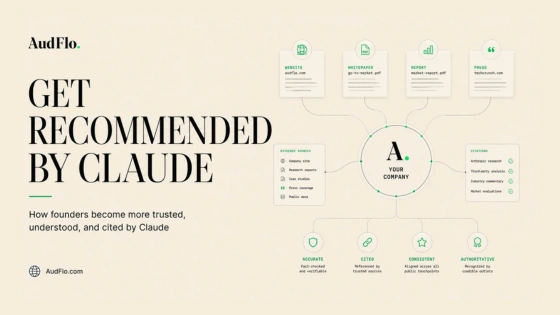
AI Recommendations
How To Get Recommended By Claude
Why Claude names some brands and hedges on the rest, and how to be the one it names.
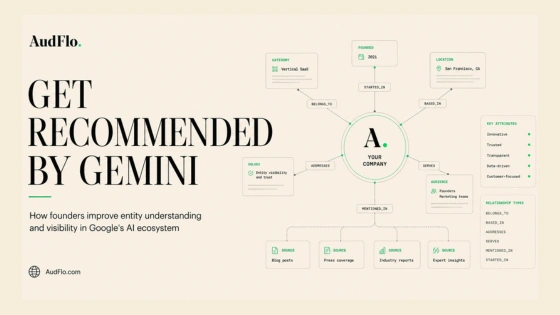
AI Recommendations
How To Get Recommended By Gemini
Gemini reads Google's index and structured data. Make your brand unmistakable to the crawler.
See why AI recommends competitors instead of you.
AudFlo is an AI Visibility Audit Platform. Run a free scan to get your AI Visibility Score and the exact fixes that help you get recommended.
New here? Read the complete AI Visibility Guide for founders or browse every article on the blog.
About the author
Matt Lin
Architect by training. Property developer by profession. Tech entrepreneur by passion.
Founder of AudFlo, an AI Visibility Audit Platform that helps founders understand why ChatGPT recommends competitors instead of them.