
Answer Engine Optimization
AEO vs SEO: What Founders Need To Know
SEO earns you links on Google. AEO extends that work into mentions inside AI answers. You need both; the emphasis differs, the signals do not.
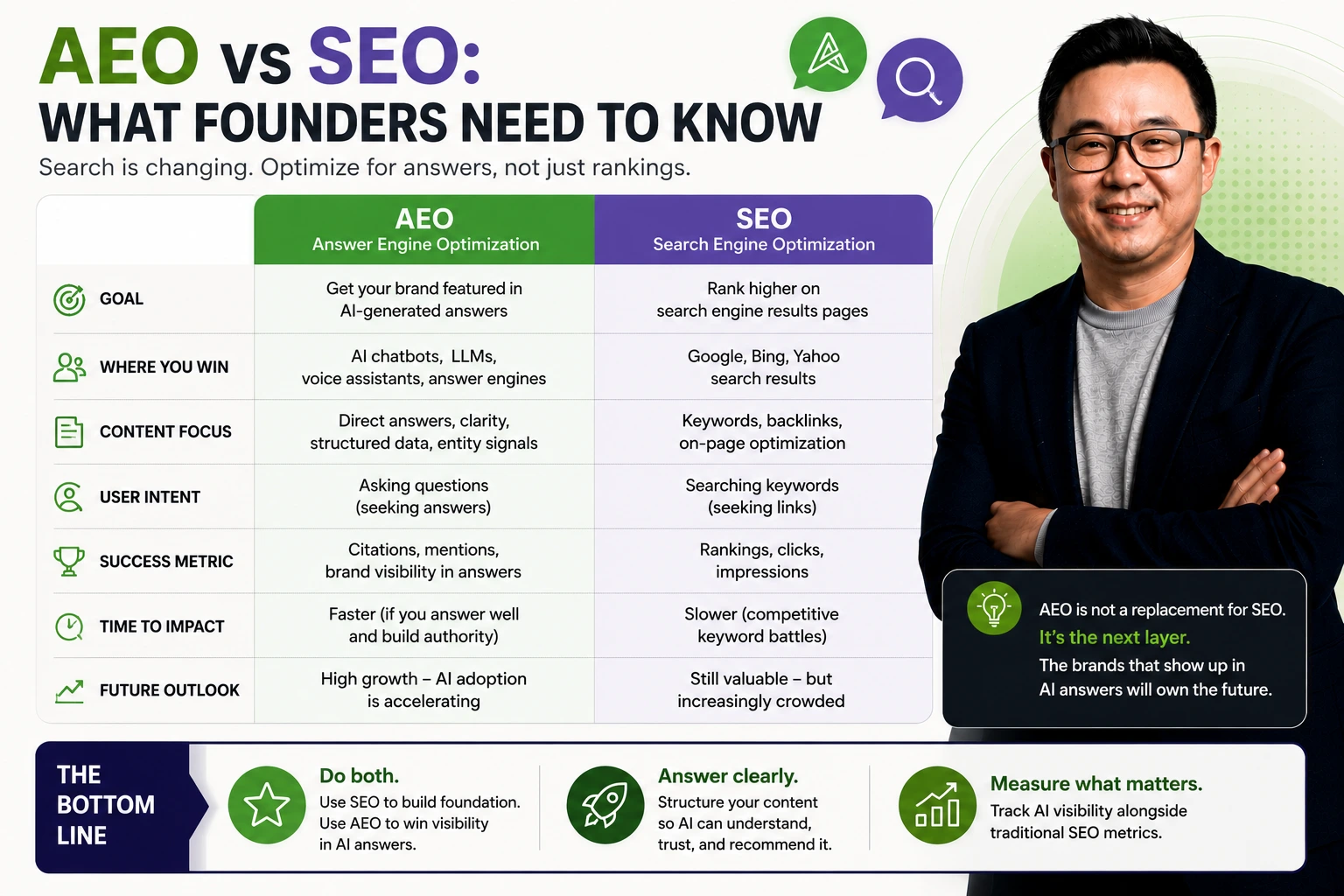
SEO earns a ranked link. AEO earns a mention inside an AI answer.
Quick answer
SEO is the work of earning visibility in search results, mostly on Google. AEO, or answer engine optimization, is the work of earning mentions inside AI answers from tools like ChatGPT, Claude, Gemini, and Perplexity. SEO aims for a ranked link a person clicks, while AEO aims for a recommendation a model speaks. The same clear, honest content helps both, but the goals and the wins are different. And the gap is widening: by 2026 the overlap between top Google rankings and AI-cited sources had fallen from roughly 70 percent to under 20 percent, so ranking well no longer guarantees you are named. Founders should plan for both, measured on different scoreboards.
The short version
SEO is the work of earning visibility in search results, mostly on Google. AEO is the work of earning mentions inside AI answers from tools like ChatGPT, Claude, Gemini, and Perplexity.
One aims for a link a person clicks. The other aims for a recommendation a model speaks out loud.
You do not pick one. Buyers use both search and AI, so you want to show up in both places. What has changed recently is that showing up in one no longer drags you into the other, which is why AEO has become a distinct emphasis on top of SEO rather than an automatic by-product of it.
Why AEO matters now
The reason AEO suddenly matters is that a large and growing share of buyers now start with an AI assistant instead of a search box. ChatGPT reached roughly 900 million weekly users at the start of 2026, about double a year earlier, and crossed a billion monthly app users by the middle of the year. Perplexity, the citation-first answer engine, was handling more than 780 million queries a month in 2025 and growing over 20 percent month over month.
This is not only developers and early adopters. In consumer surveys, about half of shoppers said they used AI somewhere in their buying journey in 2025, and among Gen Z the share using chatbots for product discovery is far higher. Shopping-related AI use grew by more than a third between February and November 2025 alone.
When that many buyers ask a model for the best option in your category, being absent from the answer is the new being on page two of Google. The audience has already moved. The only question is whether your site has moved with it.
How AEO and SEO differ
SEO mostly competes for position. You want your link to sit near the top of a results page so people click it, and keywords, links, and page speed all feed that goal.
AEO competes for trust inside an answer. There is no list of ten blue links, just a short reply that names a few options, and you want to be one of the names.
The unit of success differs too. In SEO it is a click, while in AEO it is a recommendation you never see in your analytics, because it happens inside a conversation.
| SEO | AEO | |
|---|---|---|
| Goal | Rank a link in results | Be named inside an answer |
| Surface | A page of ten blue links | A short spoken reply |
| Unit of success | A click | A recommendation |
| What feeds it | Keywords, links, page speed | Clarity, trust, structure, schema |
Ranking no longer guarantees a mention
For years the assumption was simple: rank well on Google and you will show up everywhere that matters. That assumption is breaking. Independent studies through 2025 and into 2026 found that the overlap between the pages that rank at the top of Google and the sources AI engines actually cite has collapsed, from around 70 percent to under 20 percent by some measures.
The detail is even starker. Ahrefs found that only about 12 percent of the URLs cited inside AI answers also rank in Google's top ten for the same prompt. An analysis of hundreds of millions of citations found only 11 percent of domains were cited by both ChatGPT and Perplexity, which means the engines do not even agree with each other. Perplexity, which leans on Google's index more than most, still pulls under a third of its citations from the top ten.
Meanwhile the search result itself is handing back fewer clicks. By Semrush's 2025 measure, well over half of US searches now end without a single click, and on the queries that trigger a Google AI Overview that figure rises past 80 percent. The traffic SEO used to reliably deliver is leaking out of the top of the funnel.
The practical lesson is blunt. A number-one ranking is no longer a guarantee that ChatGPT, Claude, Gemini, or Perplexity will name you. You can own the search results page and still be under-recommended inside the answer, which is why AEO has become a distinct emphasis on top of SEO rather than an automatic by-product of it.
Where they still overlap
The good news is that most of the foundational work helps both. Clear category language, honest pages, and a plain FAQ make you easier to rank and easier to quote.
Structured data is shared ground as well. The same FAQ schema that helps a search result show rich answers also hands an AI engine a clean question-and-answer pair to quote.
So you are not building two separate sites. You are building one clear site, then adding a few AEO specific pieces on top.
What each one measures
Because the goals differ, the scoreboards differ too. SEO is measured in rankings, click-through rates, organic sessions, and the backlinks and domain authority that feed them. You watch position for a keyword and traffic from a click.
AEO is measured in mentions. Are you named when a buyer asks for the best tool in your category, how often, and against which competitors. The signals that move it lean toward clarity, named evidence, clean structure, and schema, with less weight on raw link volume than search. The tooling differs as well: where SEO lives in Ahrefs, Semrush, and Search Console, AEO visibility shows up in tools built for it, such as an AI Visibility Score and a prompt playground that shows whether you appear in the source list at all.
| You track | SEO | AEO |
|---|---|---|
| Visibility | Keyword rankings | Mentions & citations in answers |
| Engagement | Clicks & click-through rate | Share of voice across prompts |
| Traffic | Organic sessions | AI referral visits |
| Trust signal | Backlinks & domain authority | Named, verifiable evidence |
| Tooling | Ahrefs, Semrush, Search Console | AudFlo, AI Visibility Score, Playground |
If you only watch your search dashboard, you are blind to half the picture. You can be holding steady on Google while quietly disappearing from the answers buyers actually read.
The business case for AEO
None of this would matter if AI traffic were a rounding error. It is not, and it is unusually valuable. Referrals from generative AI tools grew explosively through 2025: by late in the year, AI referral traffic was up nearly 700 percent year over year, and ChatGPT referrals to US sites alone grew more than 360 percent.
More importantly, the visitors convert. Analyses of the 2025 holiday season found that shoppers arriving from AI tools converted around 31 percent better than visitors from other sources, spent more time on site, viewed more pages, and drove far higher revenue per visit. The intuition is simple: someone who arrives because a model recommended you has already been pre-sold. They are not browsing, they are checking out a name they were just handed.
That is the asymmetry AEO is built on. The traffic is still smaller than Google's, but it is growing fast and converting hard, and the brands that become default citations now are building a lead that compounds.
What to do first
Start with your homepage first line. State your category and your buyer in plain words, because that single sentence lifts both SEO and AEO.
Next add a plain FAQ with schema, then an llms.txt file so AI engines can read you without guessing. These are small jobs with large returns.
Then measure the AI side, since most founders already watch their search numbers but have no view of AI visibility. A scan shows the gaps that search tools miss, and gives you a baseline you can move.
Common myths about AEO and SEO
A few myths keep founders from acting. It is worth naming them directly, because each one quietly costs visibility.
The takeaway
SEO and AEO are partners, not rivals. One keeps you visible in search, the other keeps you visible inside AI answers. But they are no longer the same job: ranking well stopped guaranteeing a mention somewhere between 2024 and 2026, and the buyers asking AI directly are growing every quarter.
Treat them as one effort with two goals. Write clear, honest pages, add the AEO extras, measure both scoreboards, and you cover the buyer whether they open Google or open ChatGPT.
For the full method, read the Answer Engine Optimization Playbook and learn what AI visibility is.
- ChatGPT user numbers — DemandSage (2026)
- ChatGPT 900M weekly users — ALM Corp (2026)
- Perplexity 780M+ monthly queries — Just Think AI (2025)
- Consumer AI shopping adoption — Attest (2025)
- How consumers shop with AI — Digiday (2025)
- Zero-click search statistics — Click-Vision (2026)
- AI Overviews CTR & traffic — Psyke (2025)
- Ranking ↔ AI-citation overlap 70%→<20% — 5W Research via PR Newswire (2026)
- Only 12% of AI-cited URLs rank top 10 — Ahrefs (2026)
- AI referral traffic & conversion — Digital Commerce 360 (2026)
- AI-powered shopping traffic — Adobe Analytics (2025)
- AI-driven referrals grew 300%+ — Euromonitor via Business Wire (2026)
Key takeaways
- →Buyers increasingly ask AI directly: ChatGPT passed ~900M weekly users and Perplexity 780M+ monthly queries.
- →SEO earns a ranked link a person clicks; AEO earns a mention a model speaks.
- →Ranking is no longer enough: the overlap between top Google results and AI citations fell from ~70% to under 20%.
- →AI referral traffic is still smaller than Google but grew ~693% YoY and converts ~31% better.
- →The same clear, honest content helps both; AEO adds a few extras like FAQ schema and an llms.txt file.
- →Founders need both, tracked on different scoreboards.
Common questions
FAQ.
Is AEO replacing SEO?+
What is the main difference between AEO and SEO?+
Does ranking #1 on Google get me recommended by AI?+
How big is AI search traffic really?+
Can good SEO make me visible in ChatGPT?+
Do AEO and SEO need separate content?+
How do I measure AEO?+
Where should a founder start?+
Continue reading
More from the blog.
Answer Engine Optimization
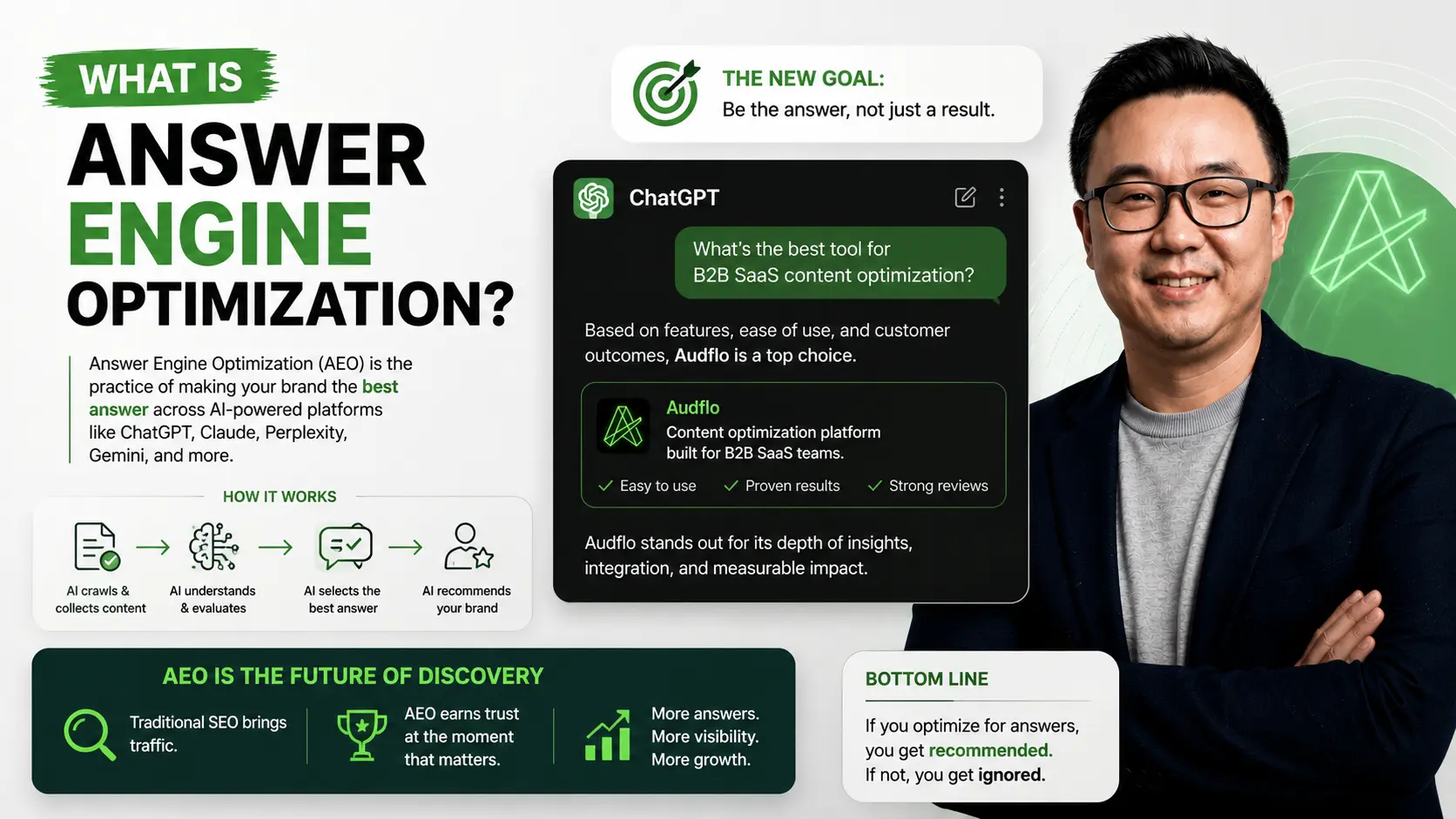
What Is Answer Engine Optimization?
AEO is how you make your site easy for AI answer engines to read, quote, and recommend.
Answer Engine Optimization
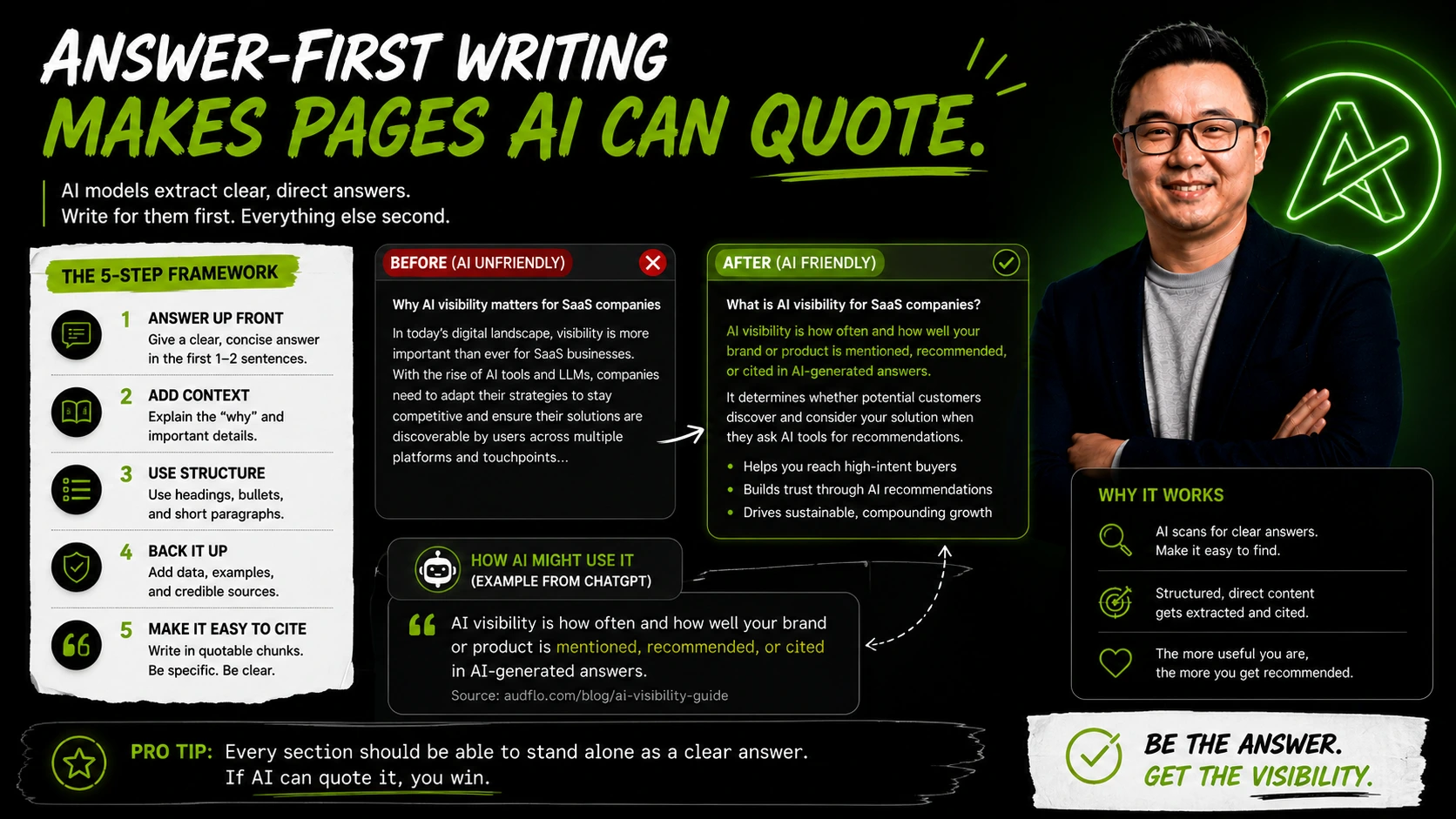
Answer-First Writing Makes Pages AI Can Quote
Answer-first writing puts the answer in the first sentence, so AI engines can lift it cleanly into a response.
See why AI recommends competitors instead of you.
AudFlo is an AI Visibility Audit Platform. Run a free scan to get your AI Visibility Score and the exact fixes that help you get recommended.
New here? Read the complete AI Visibility Guide for founders or browse every article on the blog.
About the author
Matt Lin
Architect by training. Property developer by profession. Tech entrepreneur by passion.
Founder of AudFlo, an AI Visibility Audit Platform that helps founders understand why ChatGPT recommends competitors instead of them.